
Nobel Prize for two members and discoverers of channelrhodopsins
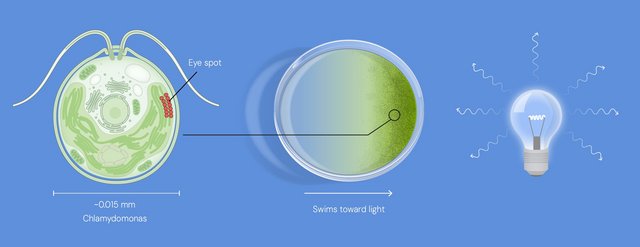 The tiny alga Chlamydomonas senses light using its eyespot, which allows it to orient itself towards light. Graph and (c): The Nobel Committee for Physiology or Medicine. Ill. Mattias Karlén
Biophysicist, phycologist, and DBG-member Professor Peter Hegemann (Humboldt University Berlin), the plant physiologist and member of our Section Phycology, Professor Georg Nagel (Würzburg University), together with Karl Deisseroth, Professor of Bioengineering and Psychiatry at Stanford University, jointly receive the 2026 Nobel Prize in Physiology or Medicine, as the Karolinska Institute in Stockholm announced yesterday. Hegemann and Nagel discovered the so-called channelrhodopsins, light-sensitive proteins, when they wanted to explain how the single-cell green alga Chlamydomonas senses light to move towards it. Together with Karl Deisseroth they developed the new the field of optogenetics, in which these light-sensitive rhodopsins were inserted into the membranes of nerve cells. This enables to switch on and off those cells with light and to study nerve cells in living organisms and living brains. Our DBG congratulates Peter Hegemann, Georg Nagel and Karl Deisseroth to this well-deserved award. The Nobel Prizes will be presented on 10th December to the awardees, the anniversary of the death of Alfred Nobel, who established the prizes.


