
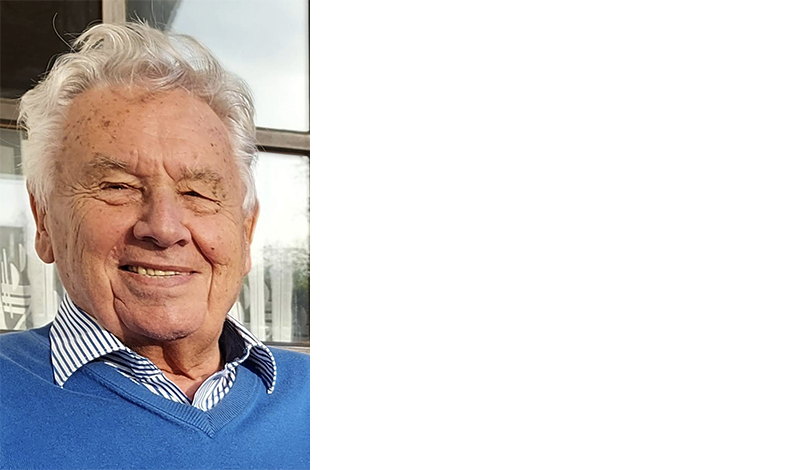
The German Society for Plant Sciences (DBG) mourns the loss of Prof. Widmar Tanner, an exceptional scientist and human being who significantly shaped and enriched international plant biology over decades. With Prof. Widmar Tanner, we lose not only one of the most important plant biologists of his generation, but also a colleague whose curiosity, openness, approachability, and intellectual independence left a lasting impression on many of us.
Munich researchers spark Tanner’s enthusiasm for science
His scientific path began in Munich, where he was influenced by outstanding figures such as the biochemist and Nobel laureate Feodor Lynen, the plant scientists Otto Kandler, Hermann Merxmüller, and Meinhart Zenk, as well as the physiologist Hansjochem Autrum. This exceptional scientific melting pot ignited his early and profound enthusiasm for science—an enthusiasm that Widmar Tanner maintained and passed on throughout his life.
Exploring metabolic processes in the USA
At the suggestion of Meinhart Zenk, his path led him to the United States, to the laboratory of Harry Beevers. Beevers’ lab was one of the few capable of analysing metabolic fluxes and conversions using 14C-labelled substrates. There, his extraordinary talent became evident: through his work on the glyoxylate cycle in castor bean seeds, he made fundamental contributions to understanding lipid mobilization in plants. Key reasons for Widmar Tanner’s early success were his tireless enthusiasm for experimentation and his ability to approach even complex questions with clarity and creativity.
Green algae and vascular plants
After returning to Munich, Widmar Tanner joined Otto Kandler’s research group and expanded his work into new areas—particularly questions concerning photosynthesis in the unicellular green alga Chlorella and the biosynthesis of complex carbohydrates in vascular plants. It was characteristic of him to select suitable model systems with great care and to derive fundamental insights from them. His work from this period—such as on the role of galactinol or dolichol phosphate mannose—impressively demonstrates his ability to place seemingly small observations into broader biological contexts.
Professor in Regensburg at the age of 32
In 1970, when he was just 32 years of age, he accepted a call to the University of Regensburg, where he assumed the Chair of Cell Biology and Plant Physiology. For many of us, this period is inseparably linked with his name: as a dedicated university teacher, as a formative figure within the faculty, and as a colleague who actively fostered scientific exchange at both national and international levels. Together with colleagues such as Karl Otto Stetter, Manfred Sumper, Rainer Jaenicke, and Andreas Bresinsky, Widmar Tanner played a decisive role in shaping the young University of Regensburg and developing his faculty into a vibrant and internationally visible centre for the life sciences.
Sugar transport and new perspectives
His scientific signature was particularly evident in his work on sugar transport. With great perseverance and precision, he and his research group succeeded in elucidating fundamental mechanisms of these processes, thereby decisively shaping this field of research. Widmar Tanner laid the foundation for plant transport biology in Germany to gain significant international recognition.
At the same time, Widmar Tanner always remained open to new questions—whether in yeast cell biology, in the study of glycosylation processes, or in the significance of membrane microdomains. A characteristic of his work was his ability to recognize connections between different disciplines and to develop new perspectives from them.
Joy of discourse, inspiring conversations, and scientific honours
Anyone who worked with Prof. Tanner remembers not only his scientific clarity but also his enjoyment of critical discourse. He asked questions where others accepted answers and was unafraid to challenge established doctrines—such as in his joint work with Harry Beevers on the relationship between transpiration and nutrient transport (Tanner and Beevers 2001, Proc. Natl. Acad. Sci., 98, 9443–47). This very attitude made him an inspiring conversational partner for many colleagues.
Recognition of his work was also reflected in numerous honours and memberships, including the European Molecular Biology Organization, the German National Academy of Sciences Leopoldina, the Bavarian Academy of Sciences and Humanities, corresponding membership in the American Society of Plant Biologists, the Sudeten German Academy of Sciences and Arts, and, since 2022, honorary membership in our German Botanical Society. Yet, more important to him than any award was always the quality of the science itself.
Paving the way for many researchers
His impact as a teacher and mentor was equally profound. Many of his students recall an atmosphere characterized by trust, intellectual freedom, respect, and high scientific standards. He had a gift for recognizing and fostering talent without prescribing a fixed path—an approach that led to numerous successful scientific careers, including Prof. Guido Grossmann (Düsseldorf), Prof. Ewald Komor (Bayreuth), Prof. Thomas Roitsch (Copenhagen), Prof. Norbert Sauer (Erlangen) and Prof. Sabine Strahl (Heidelberg).
Widmar Tanner was also remarkably engaged beyond his own field: in scientific committees, in academic self-governance, and in communicating science to society. Among other roles, he served as Vice President of his university, as a member of the Senate and (later) Executive Committee of the German Research Foundation, and as a member of the German Council of Science and Humanities. In these roles, he consistently and convincingly advocated for objective and well-founded engagement with scientific issues.
With Prof. Widmar Tanner, our community loses a scientist of great clarity and vision, a dedicated teacher, and a highly esteemed colleague. Many of us also lose a personal companion along our journey. The German Society for Plant Sciences (DBG) will honour his memory. Our thoughts are with his family and all who were close to him.
---
In May 2026
Prof. Dr. Ekkehard Neuhaus, Rhineland-Palatinate University of Technology Kaiserslautern-Landau (RPTU): https://bio.rptu.de/fgs/pflanzenphysiologie/team/neuhaus