
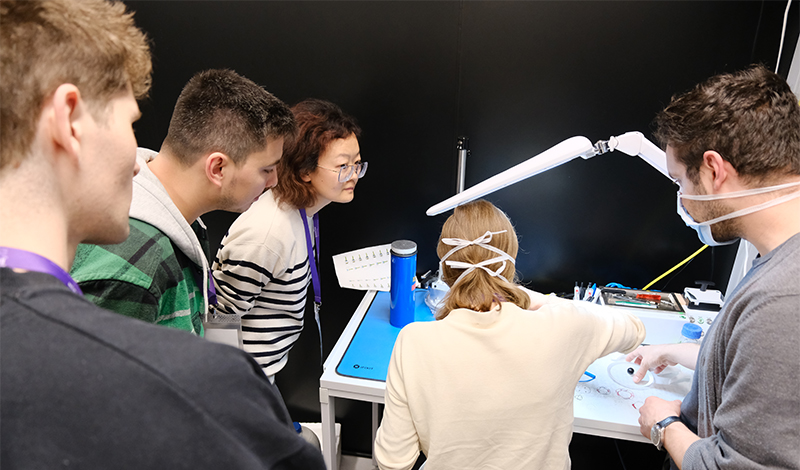
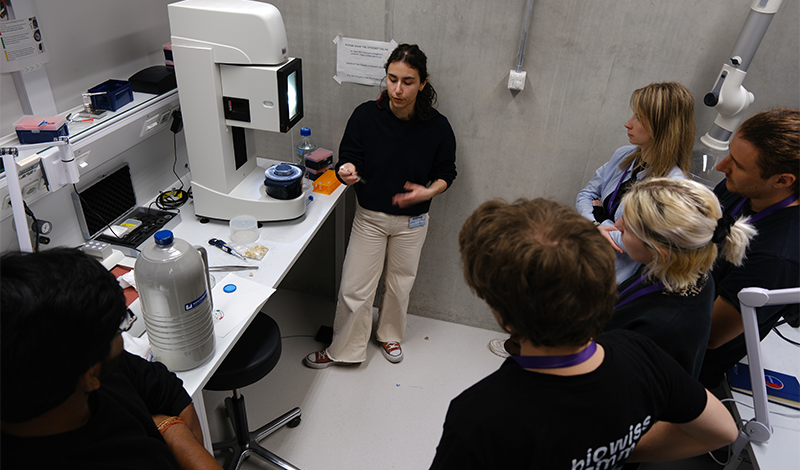
We started with a theoretical introduction into cryo electron microscopy including instrument setup, sample preparation, Fourrier transformation and contrast transfer function (CTF) correction. In the afternoon, the participants were divided into smaller groups in order to rotate through work stations in the lab of Prof. Ben Engel. Here, four co-workers demonstrated the practical sample preparation workflow of grid preparation and freeze-plunging, confocal microscopy of frozen grids FIB milling of cells on the grids and the actual control of the electron microscope.
Data and three-dimensional visualisation
The second workshop day was dedicated to data processing. Using a high-performance computing cluster of the University of Basel, the participants could analyse a tilt series of cyano bacterial samples by themselves, resulting in three-dimensional animations of beautifully coloured thylakoid membranes and photosynthetic complexes.
International keynotes
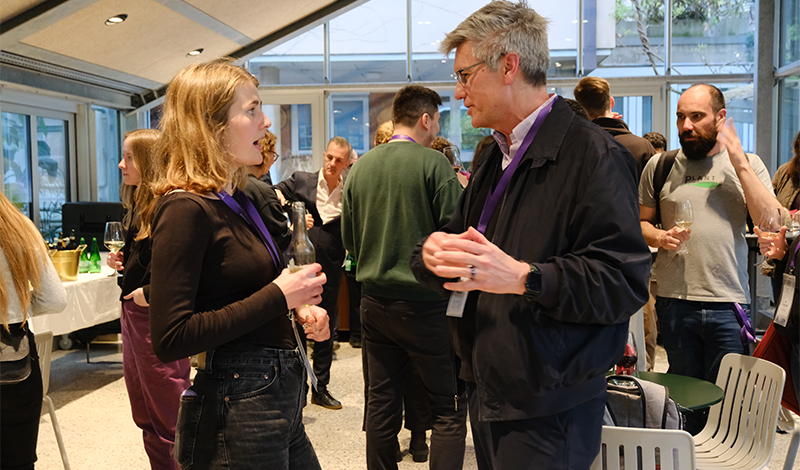
In the afternoon, the invited experts on structural biology and photosynthesis arrived. After two keynote lectures by Kevin Redding (Arizona State University) on “Light-driven electron transport in the Heliobacteria: Learning new things from the world’s simplest phototroph” and Dennis Nürnberg (Martin Luther University Halle-Wittenberg) about “Structural and functional insights into
cyanobacterial Photosystem I variants”, the participants could get into discussions with the experts during an informal Apéro in the Foyer of the Tropical House in the Botanical Gardens Basel.
Similarly, during the last day of the workshop, interaction and networking between the participants and experienced researchers was in the focus of the schedule. Having started with a keynote lecture entitled “Boosting plant photosynthetic electron transport through improved plastoquinone diffusion” by Helmut Kirchhoff (Washington State University) it was up to the PhDs and PostDocs to present their work to the audience.
Posters and in depth discussions
Five students had the chance to do this in a scientific presentation whereas others presented their work on posters. The discussions were that intense, that the time for the poster session seemed too short to many. However, everyone was happy to attend the final impulse lecture on “Equality in South America” by Dr. Ana Cislaghi, an Argentinian PostDoc of the DFG 5573 GoPMF research consortium, which co-financed the workshop.
Conclusion
Thanks to the generous funding by the DBG and the DFG-GoPMF, the participants could get a hands-on insight into the emerging technique of cryo electron tomography and most importantly get a feeling for the difficulty, time requirement and critical points during sample preparation and data analysis. This will be of good use for their upcoming experiments related to this technique. We therefore would like to thank explicitly Prof. Ben Engel for opening his lab and engaging his group members in explaining the theoretical and practical details to the participants.
----
In May 2026
Dr Davide Tamborrini (Basel https://www.cellarchlab.com/people.html), Dr Karen Zinzius (Münster https://www.uni-muenster.de/GoPMF/mitglieder/index.html#anchor_1_38), and Fanny Le Blanc (Basel https://www.cellarchlab.com/people.html)