Patrick Lederer (Heinrich-Heine-Universität Düsseldorf)
Patrick Lederer's Master thesis was awarded with the Prize for the Best Plant Science Master Thesis, which was carried out at xxUniversity in the year 2025 with the title:
Ontogenetic Dynamics of Photosynthesis in C3 and C2 Moricandia Leaves
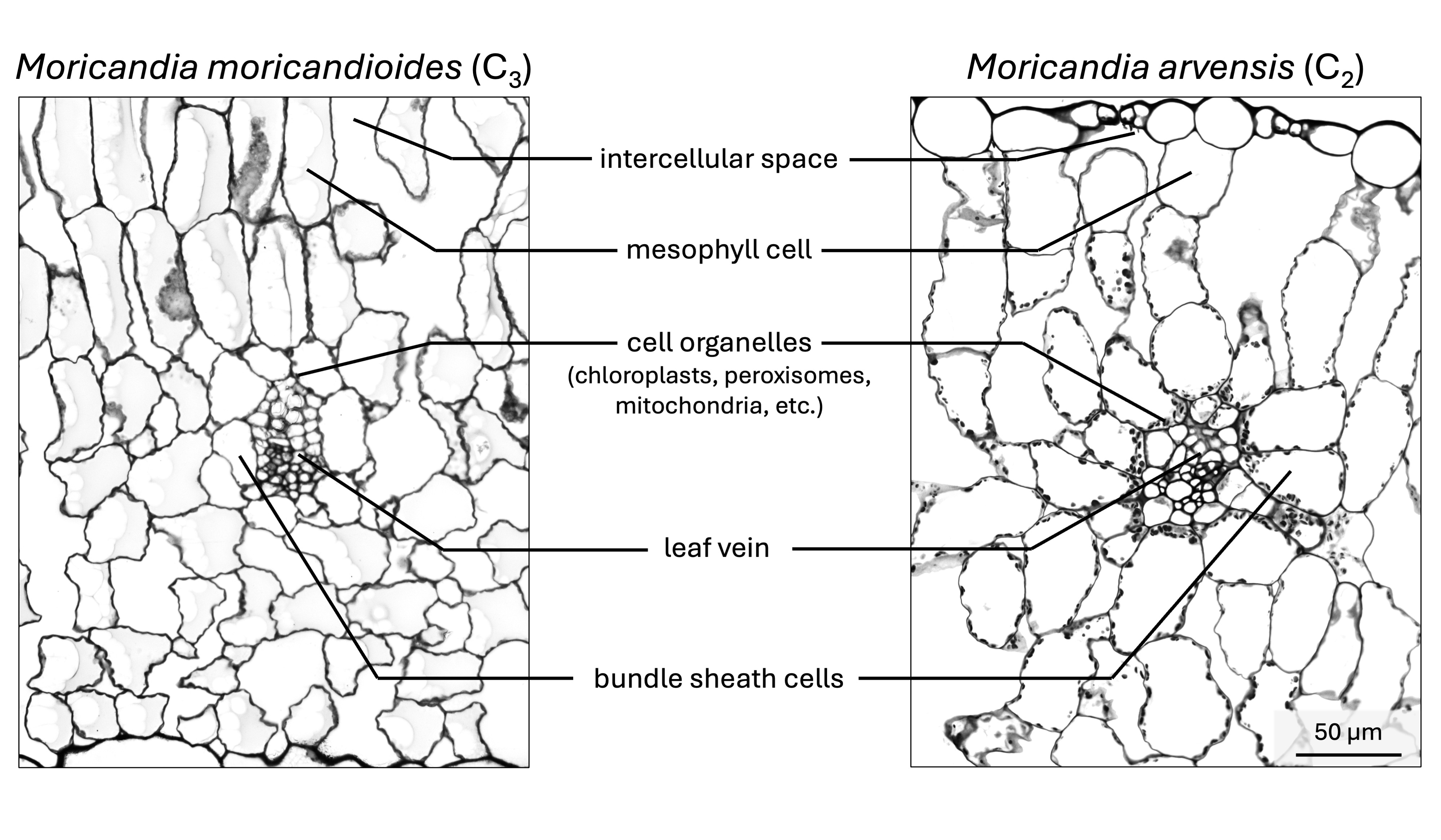
Early-established anisotropic growth of bundle sheath cells in C2 leaves fundamentally alters their shape and connectivity with neighbouring tissues.
To understand the complex evolution of efficient C₄ photosynthesis from classical C₃ photosynthesis, researchers study plants that could represent an evolutionary intermediate between C₃ and C₄ – so-called C₂ plants, which actively enrich CO₂ in bundle sheath cells under hot and dry conditions and thereby enable more efficient photosynthesis. In this study, we use the genus Moricandia to investigate how C₂ leaf anatomy differs from C₃ leaf anatomy and at which developmental stage these differences arise. We combine microscopic sections of multiple developmental stages and orientations with quantitative measurements of leaf and cell geometry and bioinformatic analyses. We show that early-established anisotropic growth generates strongly enlarged bundle sheath cells in C₂ leaves and simultaneously increases their contact with neighbouring leaf tissues, facilitating cell-to-cell transport of metabolites and better isolating the bundle sheath from the external air. Thus, leaf anatomy provides a central prerequisite for efficient recapture of CO₂. Our results provide new insights into the developmental mechanisms underlying the evolution of novel photosynthetic types and contribute to a better understanding of more efficient photosynthesis as well as to long-term strategies for securing crop yields under increasingly extreme climatic conditions.
___
Patrick Lederer conducted this work at the Institute of Plant Biochemistry in the research group of Prof. Dr. Andreas Weber.