Stella Drechsler (Philipps-Universität Marburg)
Stella MC Drechsler's Master thesis was awarded with the Prize for the Best Plant Science Master Thesis, which was carried out at Marburg University in the year 2025 with the title:
Recovery dynamics of tree seedling communities within a tropical rainforest ecosystem
This study uses a novel experimental design to investigate tree seedling regeneration in a tropical rainforest in Ecuador by combining aboveground perturbation with the exclusion of terrestrial mammals. By integrating local experimental effects with landscape factors on formerly agricultural plots, it provides a multi-scale perspective on secondary forest regeneration.
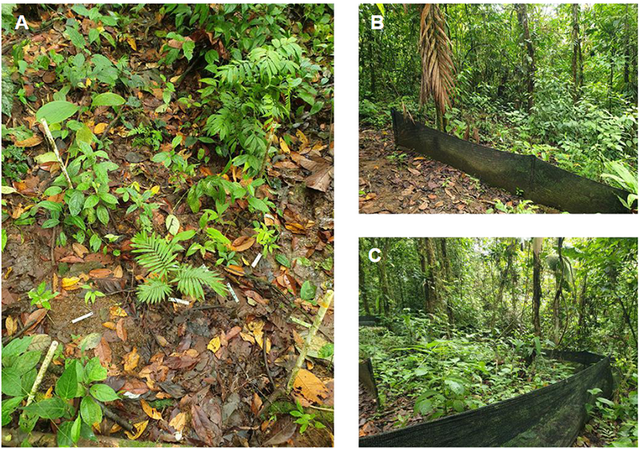
Today, secondary forests account for over 60% of forested areas worldwide and have great potential for conserving tropical biodiversity while providing essential ecosystem functions and services. In this study, we investigated the recovery of tree seedlings - a key bottleneck in forest regeneration - in a lowland tropical rainforest in the Ecuadorian Chocó. We analyzed the influence of (a)biotic drivers at both landscape and local scales along a chronosequence ranging from 0 to 39 years since abandonment of cacao production or pastures, using old-growth forest as a reference. To study local effects, we implemented a full-factorial experiment within the chronosequence, combining aboveground perturbation (small vegetation, litter, and soil removal) and the exclusion of terrestrial mammals using fencing.
Our results show that, at the landscape scale, tree seedling abundance, diversity, and composition increasingly resembled those of old-growth forests with regeneration time. Former cacao plantations initially supported higher tree seedling abundance and diversity than pastures, but these differences diminished with regeneration time. The surrounding landscape with higher surrounding forest cover and lower elevations further promoted higher abundance and diversity. At the local scale, experimental treatments did not affect abundance and diversity; however, seedling composition in former pasture plots was more strongly altered by perturbation than by mammal exclusion, suggesting legacy-specific responses to these disturbances.
Overall, our findings highlight the complex interplay between land-use legacy, surrounding landscape, and local disturbances in shaping forest recovery. This study emphasizes the need for integrated, multi-scale conservation and restoration strategies to support the recovery of tropical secondary forests.
___
Stella Drechsler conducted this work at the department of nature conservation at Philipps-University Marburg in the working group of Prof. Dr. Nina Farwig.