
From molecular labels to a systems-level regulatory layer
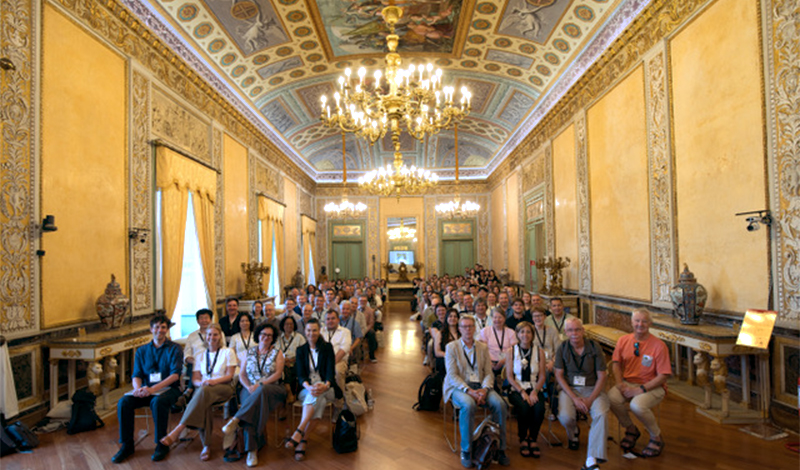
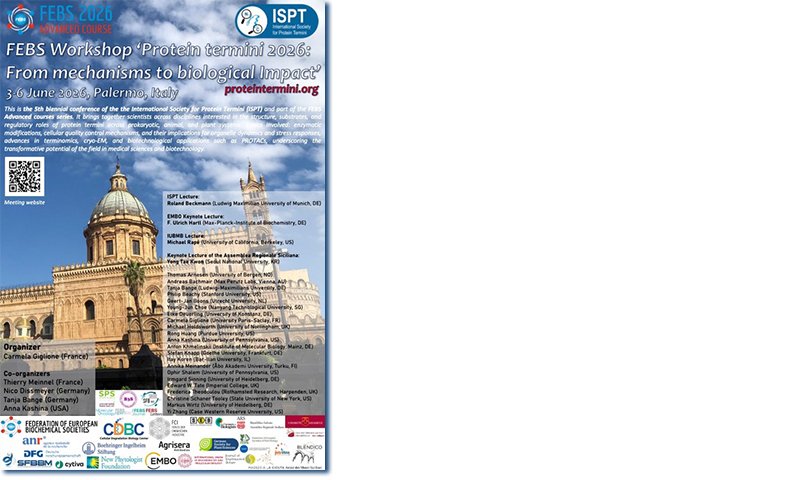
From 3–6 June 2026, 152 scientists gathered in Palermo, Sicily, for the FEBS Workshop “Protein Termini 2026: From Mechanisms to Biological Impact”. The meeting was the fifth conference of the International Society for Protein Termini (ISPT) and continued a series of international meetings that began in Halle in 2017, followed by Prague, Seoul, Bergen and Oxford. The conference took place at the Palazzo dei Normanni (Palazzo Reale), the seat of the Sicilian Regional Assembly and thus the institutional home of Sicily’s regional parliament. This distinctive setting brought together researchers from molecular and structural biology, biochemistry, proteomics, plant science, medicine and biotechnology.
Protein N- and C-termini have traditionally been viewed as sites carrying molecular signals that influence protein localisation, modification or degradation. A central conclusion emerging from the Palermo meeting was that this view is becoming too narrow. Protein termini are increasingly understood as part of an integrated regulatory layer connecting protein biogenesis, co-translational processing, proteostasis, signalling, environmental responses and disease.
Protein-terminal regulation starts at the ribosome
One particularly striking conceptual development was the increasing focus on events occurring while a protein is still being synthesised. Structural, biochemical and cell-biological work presented at the meeting placed the ribosome at the centre of a highly coordinated network of protein maturation processes. Rather than acting only sequentially after translation, methionine aminopeptidases, N-terminal acetyltransferases, N-myristoyltransferases, molecular chaperones and targeting factors can interact with the emerging nascent chain and with each other at the ribosomal exit tunnel.
This supports an important new perspective: protein-terminal biology begins during translation rather than after it. The field is consequently moving from studying isolated terminal modifications towards understanding how processing, folding, targeting and degradation decisions are coordinated during protein biogenesis.
A related development is the growing recognition of proteoform diversity. Alternative translation initiation and proteolytic processing can generate multiple protein species with different termini from the same gene. Terminomics and other proteome-wide approaches are revealing a previously hidden landscape of such terminally defined proteoforms. Similarly, N-terminal acetylation is moving beyond the cataloguing of individual modification events towards understanding how it shapes proteostasis and cellular states at a systems level.
N-degrons: beyond protein degradation
The N-degron pathway remains a major focus of the Protein Termini community, and here the questions being asked are changing as well. Rather than simply identifying new degradation substrates, current work asks how degrons and their recognition machinery are integrated into metabolism, signalling and stress responses. New substrate specificities of N-recognins are being uncovered, while terminal degrons are increasingly viewed as dynamic regulatory elements embedded in broader cellular networks.
At the same time, these fundamental mechanisms are becoming attractive tools for manipulating protein abundance. Sessions on therapeutic applications highlighted degron mimetics, targeted protein degradation, terminal-modification inhibitors and related strategies. Compared with earlier Protein Termini meetings, this translational dimension was particularly prominent in Palermo, illustrating how rapidly the distance between fundamental protein-terminal biology and therapeutic development is shrinking.
Plant biology as a source of fundamental principles
For the plant science community, an important message from Palermo was that plants are not merely systems in which mechanisms discovered in animals are subsequently tested. Plant research is actively revealing fundamental principles of protein-terminal regulation.
Several contributions illustrated this particularly clearly: N-terminal cysteine oxidation and the associated oxygen-sensing N-degron pathway provide an elegant mechanism through which plants couple environmental oxygen availability to protein stability. Work on N-degron pathways further demonstrated their importance for plant development and environmental responses. Other presentations addressed N-terminal processing in plastids, chloroplast proteostasis, abiotic-stress adaptation and the sophisticated maturation of abundant proteins such as Rubisco.
Together, these studies highlight how the evolutionary diversity of plants, animals and microorganisms can be exploited to discover both conserved and kingdom-specific principles of terminal protein regulation. Comparative approaches across biological systems may therefore become increasingly important for understanding the full regulatory potential encoded at protein termini.
Early-career researchers at the centre of the meeting
A defining feature of Protein Termini 2026 was the strong involvement of early-career researchers. Of the 152 participants, 73 were ECRs, and 30 travel grants helped young researchers attend the meeting. ECRs were not restricted to poster presentations: abstract-selected short talks and three-minute poster slams provided extensive opportunities to present research, and young scientists co-chaired scientific sessions together with senior investigators.
Dedicated ECR Meet & Greet corners, speed-networking sessions and rotating mentor dinners were integrated into the programme. The 62 posters generated particularly lively discussions, often continuing late into the evening. Six poster prizes and three oral presentation prizes recognised outstanding contributions. The meeting brought together researchers from four continents and more than 20 countries, emphasising the increasingly international character of the Protein Termini community. Guided discussions on new technologies, sustainability in science and future research directions complemented the scientific sessions and encouraged exchange across career stages and disciplines
Where is the field going?
The meeting concluded with an interactive group reflection entitled “Where Is the Field Going?”. Looking across four days of presentations and discussions, several transitions became apparent: from N-termini towards protein biogenesis, from degradation towards proteostasis, from individual modifications towards integrated modification networks, from single substrates towards proteome-wide regulation, and from molecular mechanisms towards mechanisms combined with disease biology and therapeutic applications.
Conclusion and future challenges
Perhaps the most concise conclusion from Palermo is therefore that protein termini are evolving from molecular labels at the ends of proteins into a systems-level regulatory layer linking translation, proteostasis, signalling, adaptation and disease.
The challenge for the coming years will be to integrate these processes mechanistically and quantitatively – and to determine how the remarkable regulatory potential of protein termini can be exploited in plant biotechnology, medicine and other areas of applied biology.
Acknowledgements
The organisers gratefully acknowledge the Deutsche Botanische Gesellschaft (DBG) for supporting Protein Termini 2026. We also thank FEBS and the numerous scientific organisations, foundations and sponsors whose support helped keep participation accessible and enabled extensive support for early-career researchers.
---
Prof. Dr. Nico Dissmeyer, University of Osnabrück